
How to Spot a Real Deal (and a Dressed-Up Regular Price)
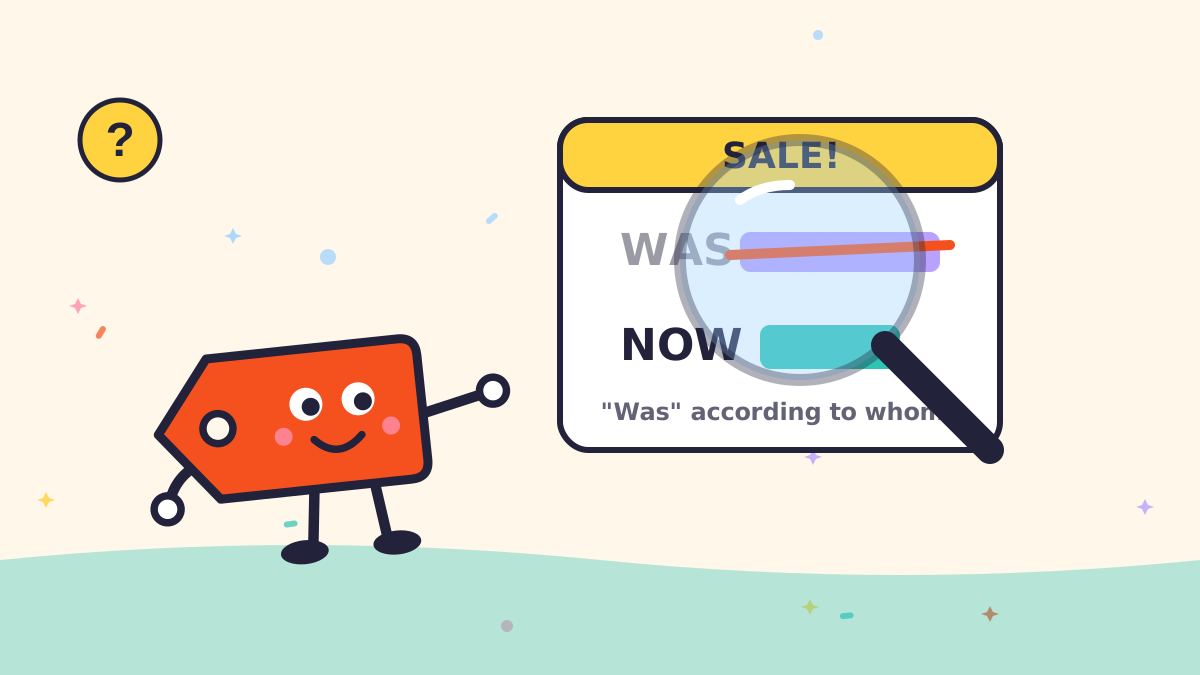
A discount is only as honest as the number it is measured against. "40% off" sounds precise, but it tells you nothing until you know what the 40% is taken from, and whether anybody ever actually paid that starting price. Most of the skill of deal hunting is learning to look past the percentage and ask a few boring questions about the baseline, the total and the timing.
This guide walks through those questions in the order we find easiest to use while you are standing in a checkout flow with a timer ticking down in the corner.
Start with the reference price, not the percentage
Every sale tag has two numbers: the price you pay and a reference price it is compared against. Retailers label that reference in different ways, such as "was", "compare at", "list price", "MSRP" or "regular price", and those labels are not interchangeable. A "was" price suggests the same seller charged it recently. "Compare at" often points to what other sellers supposedly charge. MSRP is the manufacturer's suggested price, which many products rarely sell at for long.
In the United States, the Federal Trade Commission's long-standing guides on deceptive pricing say a former-price comparison should be based on a price the item was actually offered at, in good faith, for a reasonably substantial period. Many states have their own rules too. That does not mean every reference price you see is reliable; it means a vague or inflated one is a reason to slow down, not a reason to buy faster.
A useful habit: mentally delete the reference price and look only at the number you would pay. Then ask whether that number is good compared with what the item usually costs, which is a different question from whether it is lower than the tag says.
Five checks that take under two minutes
You do not need special software to sanity-check most offers. The table below lists the quick checks we lean on, what each one tells you, and the warning sign to watch for.
| Check | How to do it | Warning sign |
|---|---|---|
| Usual price | Look at the item's price history in a tracker or your own notes, or check it at two other sellers. | The "sale" price matches what it has cost most of the year. |
| Same item | Compare model number, size, pack count, colour and condition. | The deal is on a slightly different model, a smaller bundle or a refurbished unit. |
| Total cost | Add shipping, taxes, mandatory fees and any required add-ons. | The item is cheap but delivery or a "service fee" erases the gap. |
| Conditions | Read the small print for minimum spend, membership, first-order-only or subscription requirements. | The headline price only applies if you sign up for something recurring. |
| Exit route | Check the return window, who pays return shipping and whether the item is final sale. | Deep discounts marked non-returnable on things that often need returning, like shoes. |
Red flags that deserve a second look
Some patterns show up again and again on offers that are less generous than they look. None of them proves a deal is bad, but each is a cue to run the checks above.
- Permanent urgency. A countdown timer that resets when you reload the page, or a "sale ends tonight" banner that has been there all month.
- Round-number reference prices. A "was" price that sits suspiciously above every other seller you can find for the identical item.
- Bundles you did not ask for. "Save 30% on the set" where you only wanted one piece and the single item is not discounted at all.
- Percentages without prices. "Up to 70% off" usually means a handful of items reach 70% and most get far less.
- Pressure copy about stock. "Only 2 left!" can be true, but it is also an easy line to add to a page.
- Coupon sites that want your login. A real promo code never needs your email password or bank details to reveal it.
Worked example: comparing two "deals"
Here is an illustrative example with made-up round numbers, not a real product. Store A shows a blender "was $120, now $84, 30% off". Store B shows the same model at $89 with no sale badge at all. Store A charges $9.99 shipping under a $99 order minimum; Store B ships free. Store A's sale is final; Store B gives 30 days to return.
On the headline alone, Store A looks like the win. On total cost, Store A is $93.99 and Store B is $89. On flexibility, Store B also lets you change your mind. The "30% off" badge was measuring against a reference price that did not matter to your decision. This is the most common way a real-looking deal turns out to be the more expensive choice.
If you want a printable version of this comparison, our checkout comparison worksheet and the short deal checklist are built for exactly this moment.
When a real discount still is not a deal for you
A price can be genuinely low and still be a poor buy. If you would not have bought the item at its usual price in the next few months, the "saving" is money spent rather than money kept. If the cheaper version is noticeably lower quality and you will replace it sooner, the per-year cost may be higher. And if a deal pushes you to buy three of something perishable, you are only saving if you use all three.
A simple test: write down what you would pay today for this exact item if it were not on sale. If the sale price is below that number and the item was already on your list, it is a deal. If the number you wrote is zero, it is a purchase you did not plan.
Frequently asked questions
Is MSRP a fair reference price?
Sometimes, but not reliably. Many products routinely sell below the manufacturer's suggested price, so a discount measured from MSRP can overstate the saving. Compare against what the item actually sells for.
How can I tell what an item usually costs?
Use a price-history tool if one covers the store, check the same model at two or three other sellers, or keep a simple note of prices you see for things you buy often.
Are countdown timers always fake?
No. Many are tied to real promotion end dates. The issue is that a timer is not evidence the price is good, so treat it as a reminder to check, not a reason to skip checking.
What is the single most useful check?
Total cost for the identical item, including shipping, fees and any required add-ons, compared with at least one other seller.
Related articles
 TimingPrice Tracking Basics: Watch Prices So You Don't Have to GuessHow price tracking works, how to read a price-history chart, how to set a sensible target price and alert, and when waiting is (and isn't) worth it.Read the guide
 CouponsCoupon Stacking Explained: What Combines, What Doesn't, and WhyHow coupon stacking works in plain terms: store vs manufacturer coupons, promo codes, cashback and card offers, the order discounts apply in, and the rules that stop a stack.Read the guide
 CheckoutFree Shipping Thresholds: When Adding to Cart Saves Money (and When It Doesn't)The math behind free-shipping minimums, when a filler item makes sense, alternatives like in-store pickup, and how shipping memberships compare.Read the guide